Category: Business

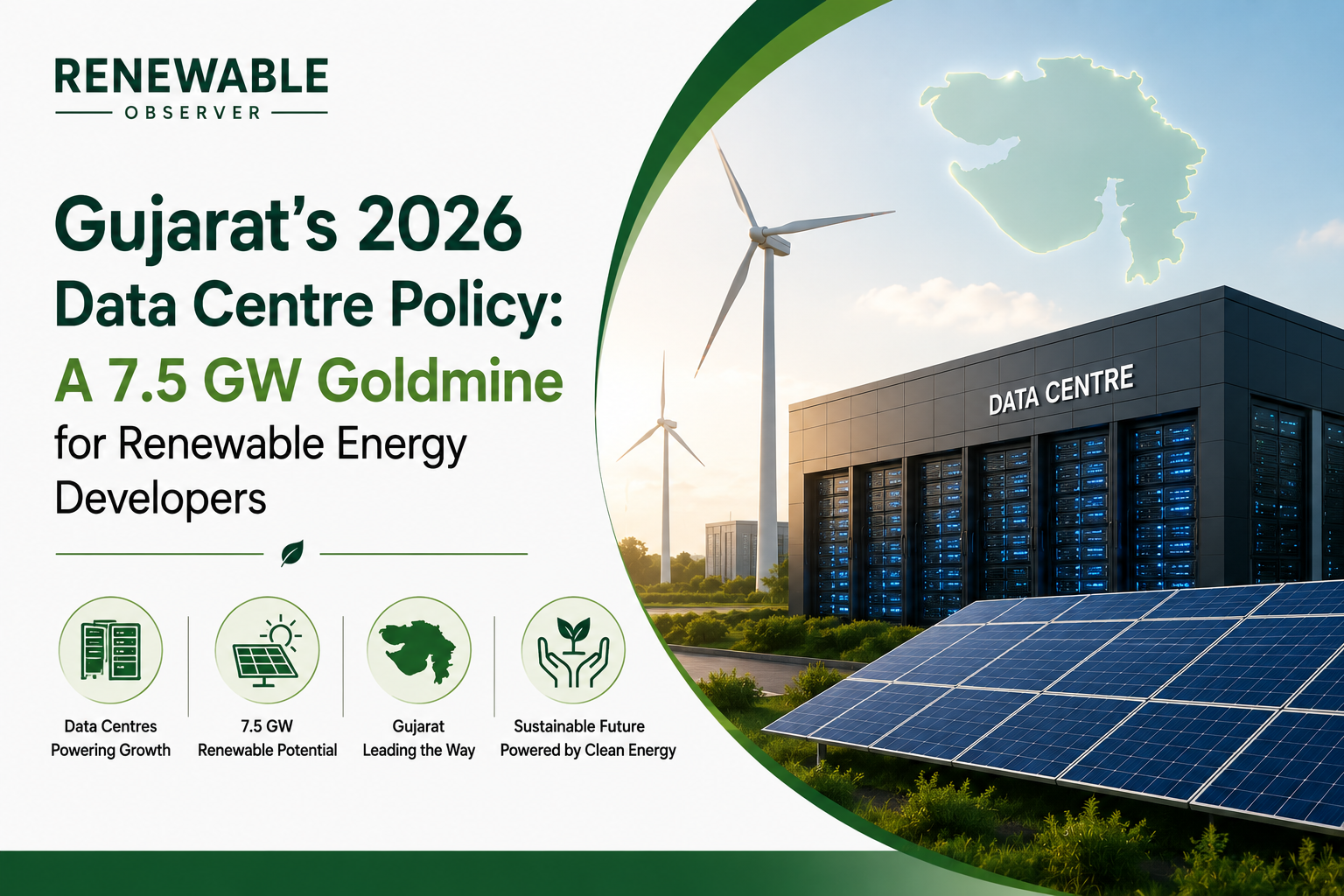
  • Gujarat’s 2026 Data Centre Policy: A 7.5 GW Goldmine for Renewable Energy Developers

    Gujarat’s 2026 Data Centre Policy: A 7.5 GW Goldmine for Renewable Energy Developers

    The explosion of Artificial Intelligence (AI) and cloud computing in India is creating an unprecedented demand for data centres. However, these hyperscale facilities are incredibly energy-intensive. To support this digital boom sustainably, the Gujarat government has launched the Viksit Gujarat Data Center Policy (2026-29).

    For renewable energy developers and Independent Power Producers (IPPs), this policy represents one of the largest single-state opportunities of the decade. Here is a breakdown of the policy mandates and how it translates into massive power purchase agreements (PPAs) for clean energy.

    1. The 7.5 GW Ambition

    Gujarat’s new policy targets total investments of ₹6 lakh crore and aims the creation of 7.5 gigawatts (GW) of new data centre capacity by 2029, making it the most ambitious state-level framework in the country.

    To put this into perspective, a single 150 MW data centre requires the equivalent power of a small city. Scaling up to 7.5 GW of IT load will require dedicated, gigawatt-scale power generation assets acting as the backbone for these technological hubs.

    2. The 51% Green Energy Mandate

    The most critical aspect of the policy for the clean tech sector is its strict sustainability requirement. Under the new framework, any data centre entity setting up in Gujarat must ensure that at least 51% of the electricity consumed for its core operations comes from green and renewable sources.

    This mandate is already reshaping how tech giants secure power:

    • Reliance and Meta: Reliance Industries recently partnered with Meta to lease a 168 MW AI-enabled data centre in Jamnagar, Gujarat. The facility will be powered entirely by renewable energy.
    • AdaniConneX: The Adani Group is building a 5 GW data centre platform across India, which will be heavily powered by the massive Adani Green Energy park located at Khavda in Kutch.

    This 51% threshold ensures that every new data centre built in the state will automatically trigger corresponding demand for utility-scale solar, wind, and battery storage projects.

    3. Deep Financial Incentives Driving Growth

    To attract hyperscalers and ensure these projects are economically viable, the state government has rolled out aggressive financial incentives. These indirectly benefit power producers by ensuring the long-term financial health of their primary off-takers (the data centres).

    • Electricity Duty Reimbursement: The policy offers a 100% reimbursement on electricity duty for a period of 20 years.
    • Power Subsidy: It provides an additional subsidy at the rate of ₹1 per unit of power consumed by the data centre for 20 years from the commencement of commercial operations.
    • Infrastructure Support: Total exemption on stamp duty and registration fees for leasing or buying land, along with full reimbursement of eligible expenses on plant, machinery, and building infrastructure.

    4. What This Means for EPCs and Developers

    The intersection of tech and energy is the new frontier. Data centres require high reliability—often aiming for 99.999% uptime. Because solar and wind are intermittent, renewable developers bidding for these lucrative corporate PPAs cannot simply offer daytime solar.

    To capture this market, EPCs must pivot toward Round-The-Clock (RTC) renewable solutions. This means integrating massive Battery Energy Storage Systems (BESS) or Pumped Hydro Storage with solar-wind hybrid parks to guarantee firm, dispatchable clean power to these digital fortresses.

    For more insights into the broader government initiatives shaping this sector, you can check out this Budget 2026: Fresh Push for Renewable Energy. This video discusses the broader government policy frameworks and budget incentives driving the expansion of clean infrastructure across India.


  • Tata Power Launches ‘Vidyut Dhaara’ to Showcase the Human Impact of Energy Beyond the Grid

    Tata Power Launches ‘Vidyut Dhaara’ to Showcase the Human Impact of Energy Beyond the Grid

    Tata Power has unveiled ‘Vidyut Dhaara’, a new purpose-led storytelling initiative that highlights how energy creates impact far beyond powering homes, businesses, and industries. The initiative reflects the company’s commitment to empowering communities, enabling livelihoods, fostering inclusion, and driving sustainable development across India.

    Conceived as a unified expression of Tata Power’s social impact journey, Vidyut Dhaara aligns with the company’s vision of empowering a billion lives through sustainable, affordable, and innovative energy solutions. It showcases how the flow of energy extends into classrooms, entrepreneurial ventures, skill development programs, and community-led sustainability efforts.

    At the heart of the initiative is an original film and title song that illustrate how energy transforms lives beyond the electricity grid. The film follows Dhaara, a young protagonist whose journey takes viewers through classrooms, workshops, fields, and communities, revealing the many ways energy fuels opportunity, resilience, inclusion, and environmental stewardship.

    The narrative highlights several of Tata Power’s flagship social initiatives, including the Tata Power Skill Development Institute (TPSDI), which equips youth with skills for green jobs and the power sector; Anokha Dhaaga, the company’s entrepreneurship and livelihood development program; Pay Autention, a pioneering initiative focused on neurodiversity awareness and inclusion; and Club Enerji, Tata Power’s long-running sustainability and energy literacy program for students.

    To bring the concept to life, Tata Power collaborated with Swarathma, the contemporary folk-rock band known for socially conscious storytelling. The partnership resulted in an original musical composition that serves as the emotional and narrative thread of the film.

    The initiative also reinforces Tata Power’s broader clean energy ambitions. The company has committed to increasing the share of clean and green energy capacity in its portfolio to 70% by 2030, reflecting its long-term focus on sustainability and renewable energy development.

    According to Tata Power, Vidyut Dhaara represents the intersection of business purpose and community progress, emphasizing that the transition to cleaner energy and the creation of more inclusive, empowered communities are interconnected goals. The initiative carries forward the legacy of founder Jamsetji Tata, whose philosophy held that businesses serve as trustees of the communities in which they operate.

    Through Vidyut Dhaara, Tata Power seeks to demonstrate how energy can power not only infrastructure and economic growth, but also aspirations, opportunities, and sustainable futures for generations to come.

  • Tata Power Launches ‘Vidyut Dhaara’ to Showcase the Human Impact of Energy Beyond the Grid

    Tata Power Launches ‘Vidyut Dhaara’ to Showcase the Human Impact of Energy Beyond the Grid

    Tata Power has unveiled ‘Vidyut Dhaara’, a new purpose-led storytelling initiative that highlights how energy creates impact far beyond powering homes, businesses, and industries. The initiative reflects the company’s commitment to empowering communities, enabling livelihoods, fostering inclusion, and driving sustainable development across India.

    Conceived as a unified expression of Tata Power’s social impact journey, Vidyut Dhaara aligns with the company’s vision of empowering a billion lives through sustainable, affordable, and innovative energy solutions. It showcases how the flow of energy extends into classrooms, entrepreneurial ventures, skill development programs, and community-led sustainability efforts.

    At the heart of the initiative is an original film and title song that illustrate how energy transforms lives beyond the electricity grid. The film follows Dhaara, a young protagonist whose journey takes viewers through classrooms, workshops, fields, and communities, revealing the many ways energy fuels opportunity, resilience, inclusion, and environmental stewardship.

    The narrative highlights several of Tata Power’s flagship social initiatives, including the Tata Power Skill Development Institute (TPSDI), which equips youth with skills for green jobs and the power sector; Anokha Dhaaga, the company’s entrepreneurship and livelihood development program; Pay Autention, a pioneering initiative focused on neurodiversity awareness and inclusion; and Club Enerji, Tata Power’s long-running sustainability and energy literacy program for students.

    To bring the concept to life, Tata Power collaborated with Swarathma, the contemporary folk-rock band known for socially conscious storytelling. The partnership resulted in an original musical composition that serves as the emotional and narrative thread of the film.

    The initiative also reinforces Tata Power’s broader clean energy ambitions. The company has committed to increasing the share of clean and green energy capacity in its portfolio to 70% by 2030, reflecting its long-term focus on sustainability and renewable energy development.

    According to Tata Power, Vidyut Dhaara represents the intersection of business purpose and community progress, emphasizing that the transition to cleaner energy and the creation of more inclusive, empowered communities are interconnected goals. The initiative carries forward the legacy of founder Jamsetji Tata, whose philosophy held that businesses serve as trustees of the communities in which they operate.

    Through Vidyut Dhaara, Tata Power seeks to demonstrate how energy can power not only infrastructure and economic growth, but also aspirations, opportunities, and sustainable futures for generations to come.

  • Tata Power Launches ‘Vidyut Dhaara’ to Showcase the Human Impact of Energy Beyond the Grid

    Tata Power Launches ‘Vidyut Dhaara’ to Showcase the Human Impact of Energy Beyond the Grid

    Tata Power has unveiled ‘Vidyut Dhaara’, a new purpose-led storytelling initiative that highlights how energy creates impact far beyond powering homes, businesses, and industries. The initiative reflects the company’s commitment to empowering communities, enabling livelihoods, fostering inclusion, and driving sustainable development across India.

    Conceived as a unified expression of Tata Power’s social impact journey, Vidyut Dhaara aligns with the company’s vision of empowering a billion lives through sustainable, affordable, and innovative energy solutions. It showcases how the flow of energy extends into classrooms, entrepreneurial ventures, skill development programs, and community-led sustainability efforts.

    At the heart of the initiative is an original film and title song that illustrate how energy transforms lives beyond the electricity grid. The film follows Dhaara, a young protagonist whose journey takes viewers through classrooms, workshops, fields, and communities, revealing the many ways energy fuels opportunity, resilience, inclusion, and environmental stewardship.

    The narrative highlights several of Tata Power’s flagship social initiatives, including the Tata Power Skill Development Institute (TPSDI), which equips youth with skills for green jobs and the power sector; Anokha Dhaaga, the company’s entrepreneurship and livelihood development program; Pay Autention, a pioneering initiative focused on neurodiversity awareness and inclusion; and Club Enerji, Tata Power’s long-running sustainability and energy literacy program for students.

    To bring the concept to life, Tata Power collaborated with Swarathma, the contemporary folk-rock band known for socially conscious storytelling. The partnership resulted in an original musical composition that serves as the emotional and narrative thread of the film.

    The initiative also reinforces Tata Power’s broader clean energy ambitions. The company has committed to increasing the share of clean and green energy capacity in its portfolio to 70% by 2030, reflecting its long-term focus on sustainability and renewable energy development.

    According to Tata Power, Vidyut Dhaara represents the intersection of business purpose and community progress, emphasizing that the transition to cleaner energy and the creation of more inclusive, empowered communities are interconnected goals. The initiative carries forward the legacy of founder Jamsetji Tata, whose philosophy held that businesses serve as trustees of the communities in which they operate.

    Through Vidyut Dhaara, Tata Power seeks to demonstrate how energy can power not only infrastructure and economic growth, but also aspirations, opportunities, and sustainable futures for generations to come.

  • Tata Power Launches ‘Vidyut Dhaara’ to Showcase the Human Impact of Energy Beyond the Grid

    Tata Power Launches ‘Vidyut Dhaara’ to Showcase the Human Impact of Energy Beyond the Grid

    Tata Power has unveiled ‘Vidyut Dhaara’, a new purpose-led storytelling initiative that highlights how energy creates impact far beyond powering homes, businesses, and industries. The initiative reflects the company’s commitment to empowering communities, enabling livelihoods, fostering inclusion, and driving sustainable development across India.

    Conceived as a unified expression of Tata Power’s social impact journey, Vidyut Dhaara aligns with the company’s vision of empowering a billion lives through sustainable, affordable, and innovative energy solutions. It showcases how the flow of energy extends into classrooms, entrepreneurial ventures, skill development programs, and community-led sustainability efforts.

    At the heart of the initiative is an original film and title song that illustrate how energy transforms lives beyond the electricity grid. The film follows Dhaara, a young protagonist whose journey takes viewers through classrooms, workshops, fields, and communities, revealing the many ways energy fuels opportunity, resilience, inclusion, and environmental stewardship.

    The narrative highlights several of Tata Power’s flagship social initiatives, including the Tata Power Skill Development Institute (TPSDI), which equips youth with skills for green jobs and the power sector; Anokha Dhaaga, the company’s entrepreneurship and livelihood development program; Pay Autention, a pioneering initiative focused on neurodiversity awareness and inclusion; and Club Enerji, Tata Power’s long-running sustainability and energy literacy program for students.

    To bring the concept to life, Tata Power collaborated with Swarathma, the contemporary folk-rock band known for socially conscious storytelling. The partnership resulted in an original musical composition that serves as the emotional and narrative thread of the film.

    The initiative also reinforces Tata Power’s broader clean energy ambitions. The company has committed to increasing the share of clean and green energy capacity in its portfolio to 70% by 2030, reflecting its long-term focus on sustainability and renewable energy development.

    According to Tata Power, Vidyut Dhaara represents the intersection of business purpose and community progress, emphasizing that the transition to cleaner energy and the creation of more inclusive, empowered communities are interconnected goals. The initiative carries forward the legacy of founder Jamsetji Tata, whose philosophy held that businesses serve as trustees of the communities in which they operate.

    Through Vidyut Dhaara, Tata Power seeks to demonstrate how energy can power not only infrastructure and economic growth, but also aspirations, opportunities, and sustainable futures for generations to come.

  • India Strengthens Energy Security and Digital Growth Amid Global Market Shifts: S&P Global Energy

    India Strengthens Energy Security and Digital Growth Amid Global Market Shifts: S&P Global Energy

    India’s energy sector is demonstrating resilience and adaptability amid significant shifts in global energy markets, according to the latest analysis from S&P Global Energy. While geopolitical developments continue to reshape commodity flows, India is successfully leveraging diversified supply chains, domestic energy resources and infrastructure readiness to safeguard its energy security and fuel emerging digital demand.

    Across oil, power, data centers and coal markets, S&P Global Energy experts note a common theme: India is strengthening long-term energy security while strategically positioning itself for future economic growth.

    India needs better optionality: diversified crude routes, deeper storage/inventory buffers, and credible alternatives that reduce import-linked exposure including for LPG, where structural dependence on the Gulf has been exposed. India’s crisis management has worked in the near term -but a prolonged disruption limits complacency, particularly in securing sufficient feed through the end of the year. (“Strait of Hormuz shock redraws India’s oil market strategy” by Premasish Das, Executive Director and Head of Downstream Oil Research Asia, Middle East, Africa and CIS at S&P Global Energy).

    Powering the Digital Boom: Beyond immediate fuel security, India is uniquely positioned to capitalise on the explosive growth of the global data center sector. With data center power demand in India expected to grow at more than 25 percent annually, the country is emerging as a strategic hub for Al workloads and cross-border cloud infrastructure. Furthermore, India’s power grid has remained relatively stable compared to regional peers, insulated by a lower dependence on LNG imports and a sustained push for domestic coal production. (“Powering the Digital Boom” by Jenny Yang, Global Head of Power and Renewables Research at S&P Global Energy).

    Coal as a Strategic Stabilizer: Supporting this grid stability is the continued reliance on coal as a critical balancing fuel. As global gas prices fluctuate, coal demand has proven highly resilient, ensuring a cost-effective cornerstone for India’s energy system. (“Coal as a Strategic Stabilizer” by Pritish Raj, Senior Manager, APAC & EMEA Thermal Coal at S&P Global Energy).

  • India Strengthens Energy Security and Digital Growth Amid Global Market Shifts: S&P Global Energy

    India Strengthens Energy Security and Digital Growth Amid Global Market Shifts: S&P Global Energy

    India’s energy sector is demonstrating resilience and adaptability amid significant shifts in global energy markets, according to the latest analysis from S&P Global Energy. While geopolitical developments continue to reshape commodity flows, India is successfully leveraging diversified supply chains, domestic energy resources and infrastructure readiness to safeguard its energy security and fuel emerging digital demand.

    Across oil, power, data centers and coal markets, S&P Global Energy experts note a common theme: India is strengthening long-term energy security while strategically positioning itself for future economic growth.

    India needs better optionality: diversified crude routes, deeper storage/inventory buffers, and credible alternatives that reduce import-linked exposure including for LPG, where structural dependence on the Gulf has been exposed. India’s crisis management has worked in the near term -but a prolonged disruption limits complacency, particularly in securing sufficient feed through the end of the year. (“Strait of Hormuz shock redraws India’s oil market strategy” by Premasish Das, Executive Director and Head of Downstream Oil Research Asia, Middle East, Africa and CIS at S&P Global Energy).

    Powering the Digital Boom: Beyond immediate fuel security, India is uniquely positioned to capitalise on the explosive growth of the global data center sector. With data center power demand in India expected to grow at more than 25 percent annually, the country is emerging as a strategic hub for Al workloads and cross-border cloud infrastructure. Furthermore, India’s power grid has remained relatively stable compared to regional peers, insulated by a lower dependence on LNG imports and a sustained push for domestic coal production. (“Powering the Digital Boom” by Jenny Yang, Global Head of Power and Renewables Research at S&P Global Energy).

    Coal as a Strategic Stabilizer: Supporting this grid stability is the continued reliance on coal as a critical balancing fuel. As global gas prices fluctuate, coal demand has proven highly resilient, ensuring a cost-effective cornerstone for India’s energy system. (“Coal as a Strategic Stabilizer” by Pritish Raj, Senior Manager, APAC & EMEA Thermal Coal at S&P Global Energy).

  • India Strengthens Energy Security and Digital Growth Amid Global Market Shifts: S&P Global Energy

    India Strengthens Energy Security and Digital Growth Amid Global Market Shifts: S&P Global Energy

    India’s energy sector is demonstrating resilience and adaptability amid significant shifts in global energy markets, according to the latest analysis from S&P Global Energy. While geopolitical developments continue to reshape commodity flows, India is successfully leveraging diversified supply chains, domestic energy resources and infrastructure readiness to safeguard its energy security and fuel emerging digital demand.

    Across oil, power, data centers and coal markets, S&P Global Energy experts note a common theme: India is strengthening long-term energy security while strategically positioning itself for future economic growth.

    India needs better optionality: diversified crude routes, deeper storage/inventory buffers, and credible alternatives that reduce import-linked exposure including for LPG, where structural dependence on the Gulf has been exposed. India’s crisis management has worked in the near term -but a prolonged disruption limits complacency, particularly in securing sufficient feed through the end of the year. (“Strait of Hormuz shock redraws India’s oil market strategy” by Premasish Das, Executive Director and Head of Downstream Oil Research Asia, Middle East, Africa and CIS at S&P Global Energy).

    Powering the Digital Boom: Beyond immediate fuel security, India is uniquely positioned to capitalise on the explosive growth of the global data center sector. With data center power demand in India expected to grow at more than 25 percent annually, the country is emerging as a strategic hub for Al workloads and cross-border cloud infrastructure. Furthermore, India’s power grid has remained relatively stable compared to regional peers, insulated by a lower dependence on LNG imports and a sustained push for domestic coal production. (“Powering the Digital Boom” by Jenny Yang, Global Head of Power and Renewables Research at S&P Global Energy).

    Coal as a Strategic Stabilizer: Supporting this grid stability is the continued reliance on coal as a critical balancing fuel. As global gas prices fluctuate, coal demand has proven highly resilient, ensuring a cost-effective cornerstone for India’s energy system. (“Coal as a Strategic Stabilizer” by Pritish Raj, Senior Manager, APAC & EMEA Thermal Coal at S&P Global Energy).

  • India Strengthens Energy Security and Digital Growth Amid Global Market Shifts: S&P Global Energy

    India Strengthens Energy Security and Digital Growth Amid Global Market Shifts: S&P Global Energy

    India’s energy sector is demonstrating resilience and adaptability amid significant shifts in global energy markets, according to the latest analysis from S&P Global Energy. While geopolitical developments continue to reshape commodity flows, India is successfully leveraging diversified supply chains, domestic energy resources and infrastructure readiness to safeguard its energy security and fuel emerging digital demand.

    Across oil, power, data centers and coal markets, S&P Global Energy experts note a common theme: India is strengthening long-term energy security while strategically positioning itself for future economic growth.

    India needs better optionality: diversified crude routes, deeper storage/inventory buffers, and credible alternatives that reduce import-linked exposure including for LPG, where structural dependence on the Gulf has been exposed. India’s crisis management has worked in the near term -but a prolonged disruption limits complacency, particularly in securing sufficient feed through the end of the year. (“Strait of Hormuz shock redraws India’s oil market strategy” by Premasish Das, Executive Director and Head of Downstream Oil Research Asia, Middle East, Africa and CIS at S&P Global Energy).

    Powering the Digital Boom: Beyond immediate fuel security, India is uniquely positioned to capitalise on the explosive growth of the global data center sector. With data center power demand in India expected to grow at more than 25 percent annually, the country is emerging as a strategic hub for Al workloads and cross-border cloud infrastructure. Furthermore, India’s power grid has remained relatively stable compared to regional peers, insulated by a lower dependence on LNG imports and a sustained push for domestic coal production. (“Powering the Digital Boom” by Jenny Yang, Global Head of Power and Renewables Research at S&P Global Energy).

    Coal as a Strategic Stabilizer: Supporting this grid stability is the continued reliance on coal as a critical balancing fuel. As global gas prices fluctuate, coal demand has proven highly resilient, ensuring a cost-effective cornerstone for India’s energy system. (“Coal as a Strategic Stabilizer” by Pritish Raj, Senior Manager, APAC & EMEA Thermal Coal at S&P Global Energy).

  • India Strengthens Energy Security and Digital Growth Amid Global Market Shifts: S&P Global Energy

    India Strengthens Energy Security and Digital Growth Amid Global Market Shifts: S&P Global Energy

    India’s energy sector is demonstrating resilience and adaptability amid significant shifts in global energy markets, according to the latest analysis from S&P Global Energy. While geopolitical developments continue to reshape commodity flows, India is successfully leveraging diversified supply chains, domestic energy resources and infrastructure readiness to safeguard its energy security and fuel emerging digital demand.

    Across oil, power, data centers and coal markets, S&P Global Energy experts note a common theme: India is strengthening long-term energy security while strategically positioning itself for future economic growth.

    India needs better optionality: diversified crude routes, deeper storage/inventory buffers, and credible alternatives that reduce import-linked exposure including for LPG, where structural dependence on the Gulf has been exposed. India’s crisis management has worked in the near term -but a prolonged disruption limits complacency, particularly in securing sufficient feed through the end of the year. (“Strait of Hormuz shock redraws India’s oil market strategy” by Premasish Das, Executive Director and Head of Downstream Oil Research Asia, Middle East, Africa and CIS at S&P Global Energy).

    Powering the Digital Boom: Beyond immediate fuel security, India is uniquely positioned to capitalise on the explosive growth of the global data center sector. With data center power demand in India expected to grow at more than 25 percent annually, the country is emerging as a strategic hub for Al workloads and cross-border cloud infrastructure. Furthermore, India’s power grid has remained relatively stable compared to regional peers, insulated by a lower dependence on LNG imports and a sustained push for domestic coal production. (“Powering the Digital Boom” by Jenny Yang, Global Head of Power and Renewables Research at S&P Global Energy).

    Coal as a Strategic Stabilizer: Supporting this grid stability is the continued reliance on coal as a critical balancing fuel. As global gas prices fluctuate, coal demand has proven highly resilient, ensuring a cost-effective cornerstone for India’s energy system. (“Coal as a Strategic Stabilizer” by Pritish Raj, Senior Manager, APAC & EMEA Thermal Coal at S&P Global Energy).