Category: Interviews

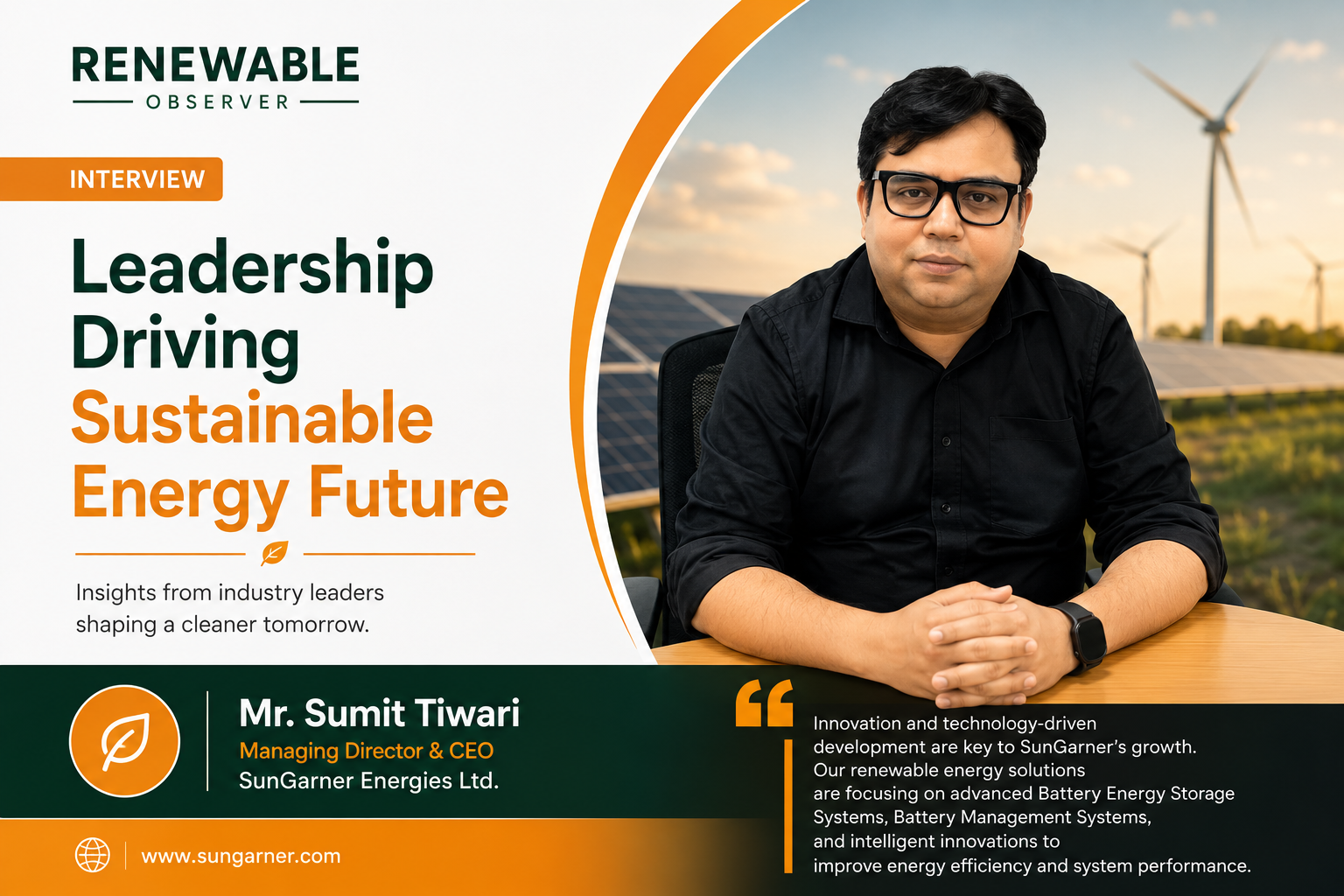
  • “We believe India is at the beginning of a multi-decade clean energy transformation,” says Sumit Tiwari, MD & CEO, SunGarner Energies Ltd.

    “We believe India is at the beginning of a multi-decade clean energy transformation,” says Sumit Tiwari, MD & CEO, SunGarner Energies Ltd.

    In an exclusive dialogue with Renewable Observer, Sumit Tiwari, MD & CEO of SunGarner Energies Ltd., maps out the company’s decade-long evolution from a rooftop solar EPC to a publicly listed, integrated renewable energy solutions provider. He discusses the critical shift toward indigenous manufacturing under the Make in India initiative, the booming potential of Battery Energy Storage Systems (BESS), and SunGarner’s strategic pivot into renewable asset ownership.

    Q1. SunGarner has grown significantly over the years. What key milestones have shaped the company’s journey and success?

    Sumit Tiwari: SunGarner’s journey has been defined by continuous evolution and our ability to adapt to the rapidly changing dynamics of the renewable energy industry.

    We started in 2015 as a Solar Rooftop EPC company, focusing strictly on delivering quality solar solutions to commercial and industrial (C&I) customers. As the market matured, we recognized the need to diversify into power electronics, initiating manufacturing activities in 2017 and significantly expanding those capabilities in 2018.

    A monumental milestone came in 2023 when SunGarner became a publicly listed company, marking a new chapter of growth, governance, and transparency. By 2024, we had expanded into Lithium-Ion Battery Manufacturing and Solar IPP (Independent Power Producer) businesses, solidifying our position across the entire renewable energy value chain. Today, we have executed projects across 26 Indian states, established solar power plants in over 12 states, exported to five countries, and developed more than 25 in-house SKUs of solar inverters and energy storage solutions.

    Beyond these operational milestones, our biggest structural strength has always been our people. The dedication of our R&D, manufacturing, execution, and sales teams has enabled us to remain agile, embrace new technologies, and stay perfectly aligned with the evolving needs of the energy transition.

    Q2. SunGarner offers solutions across solar, energy storage, EVs, and EPC. What differentiates your offerings in the highly competitive renewable energy market?

    Sumit Tiwari: What sets SunGarner apart is that we are not merely a product company or a traditional EPC contractor—we are a fully integrated renewable energy solutions provider with deep, in-house capabilities encompassing technology development, manufacturing, power system engineering, and project execution.

    We offer advanced energy storage solutions with more than 80% indigenous content, directly supporting the Government’s vision of self-reliance and domestic manufacturing.

    Innovation has been the cornerstone of our journey. We were among the early pioneers in India to develop and commercialize Solar Online UPS systems, representing a significant technological leap over conventional solar inverters. Importantly, all of our inverter designs are developed entirely in-house by our engineering and R&D teams.

    Furthermore, we do not believe in a one-size-fits-all approach. Every customer has a unique energy profile. We custom-design systems based on actual site conditions, spatial constraints, load patterns, diesel generator run hours, grid reliability, and specific commercial objectives. It is not just about selling a product; it is about engineering the most efficient, reliable energy ecosystem for every specific requirement.

    Q3. Could you share some landmark projects executed by SunGarner and their impact on the business?

    Sumit Tiwari: Every phase of our growth is anchored by projects that forced us to expand our capabilities and pushed us into new markets. A few defining milestones include:

    • The Utility Scale Leap (2018): We executed a 1.8 MWp rooftop solar installation for a textile manufacturing unit in Gorakhpur, Uttar Pradesh. At the time, it was our single largest project and proved our capacity to design and execute heavy C&I solar infrastructure.
    • Global Expansion (2021): We delivered a 180 kW Solar Project for the Bhutan Power Corporation and UNDP in Bhutan. This was our first international project, validating our technical capabilities on a global stage.
    • Energy Storage at Scale (2024): Through our channel partner network, we supplied in-house developed Solar Inverters and Battery Energy Storage solutions to more than 200 distinct sites in Tripura under a TREDA-led initiative, showcasing the rugged reliability of our indigenous technology in challenging environments.
    • IPP Transition & Ground-Mount Projects (2025): We aggressively entered the utility-scale segment, developing ground-mounted projects in Madhya Pradesh, including a 4.5 MWp DC installation at Kutiyawad. Crucially, our subsidiary, SunGarner Green Assets, signed a Power Purchase Agreement (PPA) with MPUVNL under the Kusum Yojana. This firmly established our footing in the IPP business, laying the foundation for a long-term renewable asset portfolio.

    Q4. How is SunGarner leveraging innovation and R&D to address the evolving needs of the solar and energy storage sectors?

    Sumit Tiwari: Innovation and technology development are the primary engines of our growth strategy. As the sector evolves, our R&D is heavily focused on advancing Battery Energy Storage Systems (BESS), intelligent Battery Management Systems (BMS), and next-generation inverter technologies to maximize energy efficiency and grid reliability.

    A major focus is the integration of indigenous technologies aligned with the Make in India initiative. By strengthening localized capabilities in energy storage and power electronics, we are actively reducing import dependencies while delivering high-performance solutions engineered specifically for harsh Indian operating conditions.

    Simultaneously, through our IPP platform, SG Green Asset, we are utilizing our R&D insights to develop, own, and operate renewable assets that deliver highly optimized, sustainable power to C&I customers over the long term.

    Q5. What specific growth opportunities do you see in BESS, EV charging infrastructure, and distributed solar solutions?

    Sumit Tiwari: We believe India is at the very beginning of a multi-decade clean energy transformation. Consider that India’s solar capacity has grown from roughly 2 GW in 2011 to over 120 GW today. Following that exact trajectory, BESS is poised to become the next critical pillar of the country’s infrastructure.

    As the share of intermittent solar and wind energy increases, energy storage will be absolutely essential for ensuring reliability, smoothing peak demand, and providing firm power supply across the grid.

    We also see massive, untapped growth in distributed solar solutions—spanning rooftop installations, ground-mounted PM Kusum Yojana projects, and C&I infrastructure. Parallel to this, the exponential growth of electric mobility is driving urgent demand for EV charging ecosystems. SunGarner is strategically positioned at the exact intersection of these trends, offering an integrated suite of solar inverters, lithium-ion storage solutions, and EV infrastructure technologies to capitalize on this holistic transition.

    Q6. How does SunGarner ensure quality, reliability, and long-term value across its EPC and product businesses?

    Sumit Tiwari: With a proven track record of over 10,000 installations across India, quality control is woven into our operational DNA.

    We enforce stringent quality gateways throughout the entire project lifecycle—from initial design and structural engineering to procurement, commissioning, and after-sales support. We partner only with trusted technology vendors and source high-grade components that exceed standard industry performance metrics.

    Because solar and storage assets must perform for decades, we emphasize long-term value creation through continuous performance monitoring, preventative maintenance protocols, and operational optimization, ensuring our customers realize sustainable financial returns throughout the system’s complete lifecycle.

    Q7. What are SunGarner’s key growth priorities and expansion plans to accelerate India’s clean energy transition?

    Sumit Tiwari: Our priorities are moving in lockstep with India’s national vision for energy security and self-reliance (Atmanirbhar Bharat).

    Our primary focus is deepening our capabilities across the full value chain. The next phase of India’s energy transition will not be driven by solar generation alone; it will be dictated by advanced storage and intelligent power management. Accordingly, we are heavily investing in our in-house manufacturing lines for ESS and advanced power conversion technologies.

    Another critical growth pillar is the rapid expansion of our IPP business. We aim to build a massive, diversified portfolio of renewable and storage assets that provide reliable, affordable power at scale. We are also targeting hybrid energy systems and aggressive C&I decarbonization frameworks.

    Ultimately, at SunGarner, we believe that clean energy is not just a business opportunity—it is a nation-building opportunity. Our vision is to help actively shape an energy-independent India while generating sustainable value for our customers, communities, and shareholders.
  • Engineering-First Approach Gives Solarsure an Edge in Integrated Energy Systems

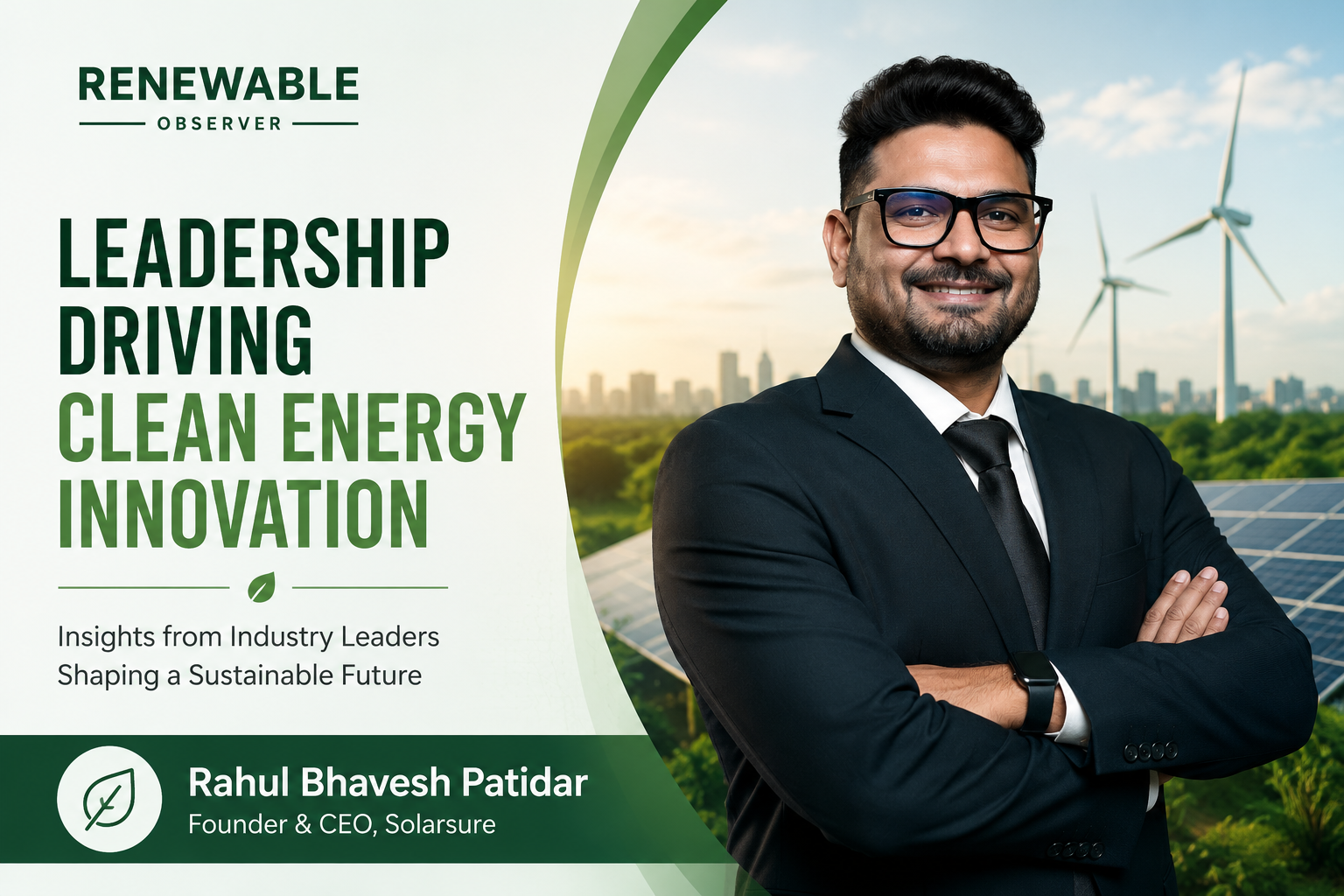
    Engineering-First Approach Gives Solarsure an Edge in Integrated Energy Systems

    In an exclusive dialogue with Renewable Observer, Bhavesh Patidar, Founder & CEO of Solarsure, breaks down how the company is moving away from the traditional, sales-driven EPC model to pioneer an engineering-led framework. He discusses the regulatory realities of cross-state scaling, the transformative dual-land potential of PM-KUSUM 2.0, and how their new technology verticals, Nevron ESS and Nevron AI, are preparing for India’s next clean energy phase.

    Q1. How does Solarsure’s technical and management-driven foundation influence project execution and customer trust?

    Bhavesh Patidar: Solarsure was built by engineers who have spent years solving complex infrastructure problems—ranging from satellite-based vegetation management for US electric utilities to climate risk modeling for power grids. That engineering DNA directly dictates how we approach every single installation.

    Most EPC companies in India’s distributed solar space function primarily as sales-led organizations that treat engineering as a cost center. We treat it as our core competitive moat. Our design workflow begins with site-specific structural analysis, PVsyst-grade energy yield simulations, and detailed general arrangement drawings, rather than generic templates scaled to fit a roof or plot.

    When a farmer in Rajasthan or a factory owner in Indore commits ₹30–50 lakh to a solar plant, they deserve the exact same engineering rigor that a 100 MW utility-scale asset receives.

    The trust piece follows naturally from that transparency. When your pre-sales team can walk a customer through clear degradation curves, module-level performance data, and realistic payback calculations rather than inflated generation projections, you build a sustainable partnership. Our high repeat and referral rates reflect that reality—customers who see one plant perform exactly as promised become our strongest brand advocates.

    Q2. What has been your strategy for scaling operations across multiple states?

    Bhavesh Patidar: We have been highly deliberate about not chasing geography simply for the sake of a larger pin map. Our expansion strategy is strictly regulation-first. We only enter states where the policy environment, grid infrastructure, and subsidy frameworks create a viable commercial case—and only when we possess the local operational depth to execute flawlessly.

    [Regulatory Framework Audit] ➔ [Local End-to-End Execution Team] ➔ [DISCOM Relationship Building] ➔ [Volume Commitment]
    

    Madhya Pradesh remains our primary stronghold, where we have built deep operational roots across the PM-KUSUM and Commercial & Industrial (C&I) ecosystems—spanning DISCOM processes to district-level administration. When we expanded into Rajasthan, it was because the Component A and C pipeline under PM-KUSUM presented a massive opportunity—exceeding 6,500 MW under Component A alone—and our MP execution playbook translated well once adapted for RVUNL and JVVNL processes.

    For each new state, our approach is identical:

    1. Understand the local regulatory framework inside out.
    2. Build a local execution team that owns delivery end-to-end.
    3. Establish robust DISCOM relationships before committing to volume.

    Parachuting a central team into a new state and hoping for the best is the fastest way to burn capital and damage your reputation. States like Gujarat, Uttar Pradesh, and Maharashtra each have highly distinct tariff structures, interconnection processes, and ground realities. Treating them as interchangeable is a critical error.

    Furthermore, our focus on vertical integration protects our pipeline. Because we handle everything from procurement through our supply chain team to project design and execution in-house, we can scale into a new state without being dependent on local intermediaries for critical functions.

    Q3. How do you see PM-KUSUM 2.0 transforming rural energy infrastructure and farmer participation?

    Bhavesh Patidar: PM-KUSUM 2.0 represents a meaningful evolution from the original scheme. The two biggest structural shifts—Agrivoltaics and Hybrid BESS (Battery Energy Storage Systems) integration—are what make it genuinely transformative rather than just an incremental expansion.

    • The Agrivoltaic Mandate: KUSUM 1.0 required farmers to dedicate land entirely to solar generation, creating a real structural tension by diverting productive agricultural land to energy. KUSUM 2.0 resolves this by promoting dual land use—solar generation above, farming below. When designed correctly, agrivoltaic structures can maintain 60–70% of crop yield while generating solar power on the exact same plot. For a farmer, this means reliable energy income without sacrificing their agricultural livelihood, changing the participation calculus entirely.
    • Hybrid BESS Integration: This addresses the fundamental limitation of the original scheme: daytime-only solar generation does not match actual agricultural load patterns. Farmers typically need power for irrigation pumps early in the morning and late in the evening—exactly when solar generation is weakest. By integrating battery storage into KUSUM projects, you create a system that serves the farmer’s real load profile rather than just exporting unutilized power to the grid.

    From an execution standpoint, these additions do increase project complexity. Agrivoltaic structures require specialized mounting designs, higher ground clearance, and crop-specific module spacing. BESS integration demands highly sophisticated system design and O&M capabilities.

    Companies accustomed to building basic ground-mount projects will find KUSUM 2.0 significantly harder to execute. For us at Solarsure, this complexity is an advantage. Our engineering-first approach and vertical integration mean we can design and deliver these integrated systems seamlessly in-house.

    Q4. Which segment currently offers the biggest near-term growth opportunity for your business?

    Bhavesh Patidar: The Commercial and Industrial (C&I) solar segment—particularly open access and group captive structures—represents the largest near-term growth opportunity, both for Solarsure and the wider industry.

    The economics are compelling and continue to strengthen. Industrial consumers in states like Madhya Pradesh, Maharashtra, and Rajasthan pay anywhere from ₹8–12 per unit for grid power. A well-structured open access solar project can deliver power at ₹5.00–5.50 per unit, making the post-tax IRR calculation straightforward for CFOs. The regulatory environment is maturing alongside this; CERC’s recent push on market coupling and state-level open access frameworks are creating far more predictable long-term revenue structures.

    Looking to the medium term, BESS is the segment I am watching most closely. As renewable penetration increases, the grid’s need for flexible storage becomes non-negotiable. We are building out our dedicated energy storage vertical, Nevron ESS, right now so we are perfectly positioned when the economics fully converge—which I believe is roughly 18–24 months away for C&I-scale applications in India.

    Hybrid systems that combine solar with storage are where real market differentiation will emerge. A C&I customer who can secure reliable 6 AM to 10 PM solar-plus-storage power without grid dependence represents a fundamentally different value proposition than daytime-only solar. That is the exact product we are engineering toward.

    Q5. What are the most common design or execution mistakes businesses make while adopting solar?

    Bhavesh Patidar: The most expensive mistake is also the most pervasive: optimizing heavily for the lowest upfront cost rather than the Levelized Cost of Energy (LCOE) over a 25-year asset lifecycle.

    This short-term optimization plays out in four highly damaging ways:

    1. Flawed Module Selection: Buyers chase the cheapest ₹/Wp price without evaluating long-term degradation warranties, temperature coefficients, or manufacturer bankability. A module that saves you ₹0.50/Wp upfront but degrades 15% faster over its lifetime costs far more in lost generation revenue.
    2. Under-Designed Structural Engineering: In Central India, we deal with wind speeds up to 150 km/h during pre-monsoon storms. I regularly see competitors use mounting structures designed only for 100 km/h to save on steel costs. The plant might survive three monsoons, but one severe storm will completely destroy a ₹2 crore installation. Structural design must follow IS 875 wind load calculations specific to the exact geographic coordinates—there is no one-size-fits-all template.
    3. Electrical Design Shortcuts: Undersized cabling, incorrect string sizing, and poor earthing systems do not show up as faults on day one. Instead, they manifest as 8–12% generation losses compounding silently year after year—or worse, as critical fire hazards.
    4. Inadequate O&M Planning: A solar plant is a 25-year asset. Without systematic automated cleaning schedules, thermal imaging for hotspot detection, inverter health monitoring, and timely component replacement, performance degrades far faster than the theoretical curve suggests. We have audited competitor-built plants that were underperforming their design estimates by 20–25% within just three years, purely due to neglected maintenance.

    Q6. How important is digital monitoring and predictive maintenance in improving solar plant efficiency?

    Bhavesh Patidar: It is rapidly becoming the single biggest differentiator between solar plants that deliver on their initial investment thesis and those that quietly underperform for years without anyone noticing.

    The core problem in the Indian market today is that most distributed solar plants are monitored purely reactively. Someone notices the facility’s electricity bill went up, calls the installer, and discovers the primary inverter has been offline for three weeks. For a 500 kW C&I plant, three weeks of downtime can mean ₹3–5 lakh in completely unrecoverable lost generation.

    At Solarsure, we are mitigating this by building out advanced AI-powered monitoring capabilities through our technology arm, Nevron AI. The real value here isn’t just a real-time dashboard—every inverter manufacturer offers that out of the box.

    The true value lies in predictive analytics: using generation data, weather correlation, and localized pattern recognition to identify degradation trends, soiling losses, and component failures before they impact performance.

    For example, our systems can flag when a specific string’s performance deviates from its expected generation curve by more than a marginal threshold—often weeks before it would be noticed through conventional monitoring. That early detection turns a potential five-figure financial loss into a routine, low-cost maintenance visit.

    For our PM-KUSUM portfolio specifically, where assets are distributed across remote rural locations, digital monitoring eliminates the need for constant physical site visits while actually improving oversight quality. A well-instrumented 2 MW plant in a remote Rajasthan village can be monitored with the exact same rigor as a utility-scale installation.

    Q7. How is Solarsure preparing for the next phase of India’s clean energy transition?

    Bhavesh Patidar: We are actively building out the Nevron Group as a vertically integrated renewable energy platform because the next phase of India’s energy transition will reward companies that can deliver comprehensive, integrated solutions—not just isolated project components.

    Our readiness strategy rests on four distinct pillars:

                      ┌───────────────────────────────┐
                      │         NEVRON GROUP          │
                      └───────────────┬───────────────┘
             ┌────────────────────────┼────────────────────────┐
    ┌────────┴────────┐      ┌────────┴────────┐      ┌────────┴────────┐
    │   NEVRON ESS    │      │   NEVRON AI     │      │  AGRIVOLTAICS   │
    │ Battery Storage │      │  Predictive AI  │      │ Dual-Land Tech  │
    └─────────────────┘      └─────────────────┘      └─────────────────┘
    
    • Nevron ESS: Our dedicated energy storage vertical. The immediate commercial opportunity is in C&I peak-shaving and demand charge management, where battery storage can deliver an attractive payback period within 4–5 years at current lithium-ion price points. As the grid moves toward time-of-day tariffs more aggressively, storage will become a mandatory component of every commercial solar proposal.
    • Advanced Agrivoltaics: This is where our PM-KUSUM expertise and agricultural roots converge. The concept of dual land use addresses the single largest socio-economic objection to ground-mounted solar in agricultural states: land diversion. We are continually refining agrivoltaic structural designs that maintain optimum crop yields while generating maximum clean power.
    • In-House Hybrid Systems: Our focus is on maintaining the absolute engineering capability to design solar-plus-storage hybrid projects entirely in-house rather than depending on external third-party system integrators. As the CERC framework for hybrid projects matures, developers who can mathematically optimize across multiple generation sources and storage profiles will capture disproportionate market value.
    • Nevron AI: Through our AI arm, we are developing predictive forecasting and analytics tools that help renewable energy operators predict generation more accurately and manage complex grid compliance—capabilities that become critical as India’s renewable mix grows beyond 30% and grid stability becomes a binding regulatory constraint.

    The companies that will lead India’s next energy phase are not simply the ones with the largest legacy installed base today. They are the ones building the technology, talent, and vertical integration required to deliver reliable, bankable renewable energy at scale. That is precisely what we are building at Nevron Group.