Category: Uncategorized

  • India Adds 30.6 GW Renewable Energy Capacity in H1 2026, Up 25% Year-on-Year

    India added 30.6 GW of renewable energy capacity during the January–June 2026 period, marking a 25% increase over the 24.5 GW added in the corresponding period last year. The growth was driven primarily by record solar installations, reflecting the country’s continued push towards expanding clean energy capacity.

    Solar power accounted for the bulk of the additions, with 26 GW of new capacity installed in the first six months of the year, a 43% year-on-year increase. The surge was led by strong growth in utility-scale projects as well as rooftop solar installations, supported by policy initiatives and rising demand. In contrast, wind capacity additions declined to around 3 GW, down 16% from the year-ago period.

    India’s total installed renewable energy capacity reached about 230 GW by the end of June 2026, further strengthening the country’s position among the world’s leading renewable energy markets. Solar continued to account for the largest share of the renewable energy mix, followed by wind, large hydro, bioenergy and small hydro projects.

    The report noted that rooftop solar recorded exceptional growth during the period, aided by the PM Surya Ghar: Muft Bijli Yojana, while utility-scale solar installations also maintained strong momentum. At the same time, the pace of wind power additions remained relatively subdued despite continued capacity expansion.

    India has been accelerating renewable energy deployment to achieve its target of 500 GW of non-fossil fuel-based installed power capacity by 2030. The robust capacity addition during the first half of 2026 highlights the sector’s sustained growth, with solar energy continuing to lead the country’s clean energy transition.

  • THDC Declares Commercial Operations of 11 MW Floating Solar Plant at Khurja

    THDC India Ltd. has declared the Commercial Operation Date (COD) for its 11 MWac Floating Solar Plant located on the Raw Water Reservoir of the Khurja Super Thermal Power Project (STPP) in Uttar Pradesh. The plant commenced commercial operations on July 17, 2026, following successful commissioning and receipt of the necessary approvals.

    With the commissioning of the floating solar project, THDC India’s total installed and commercial power generation capacity has increased to 3,918 MW. The addition also strengthens the renewable energy portfolio of the company, which is a subsidiary of NTPC Ltd.

    The new solar installation has also enhanced the overall capacity of the NTPC Group, taking its total installed capacity to 90,965 MW, while its commercial capacity has reached 89,885 MW.

    The floating solar plant has been developed on the raw water reservoir of the Khurja STPP, enabling clean energy generation without requiring additional land. The project forms part of THDC’s strategy to expand its renewable energy footprint while making efficient use of existing infrastructure.

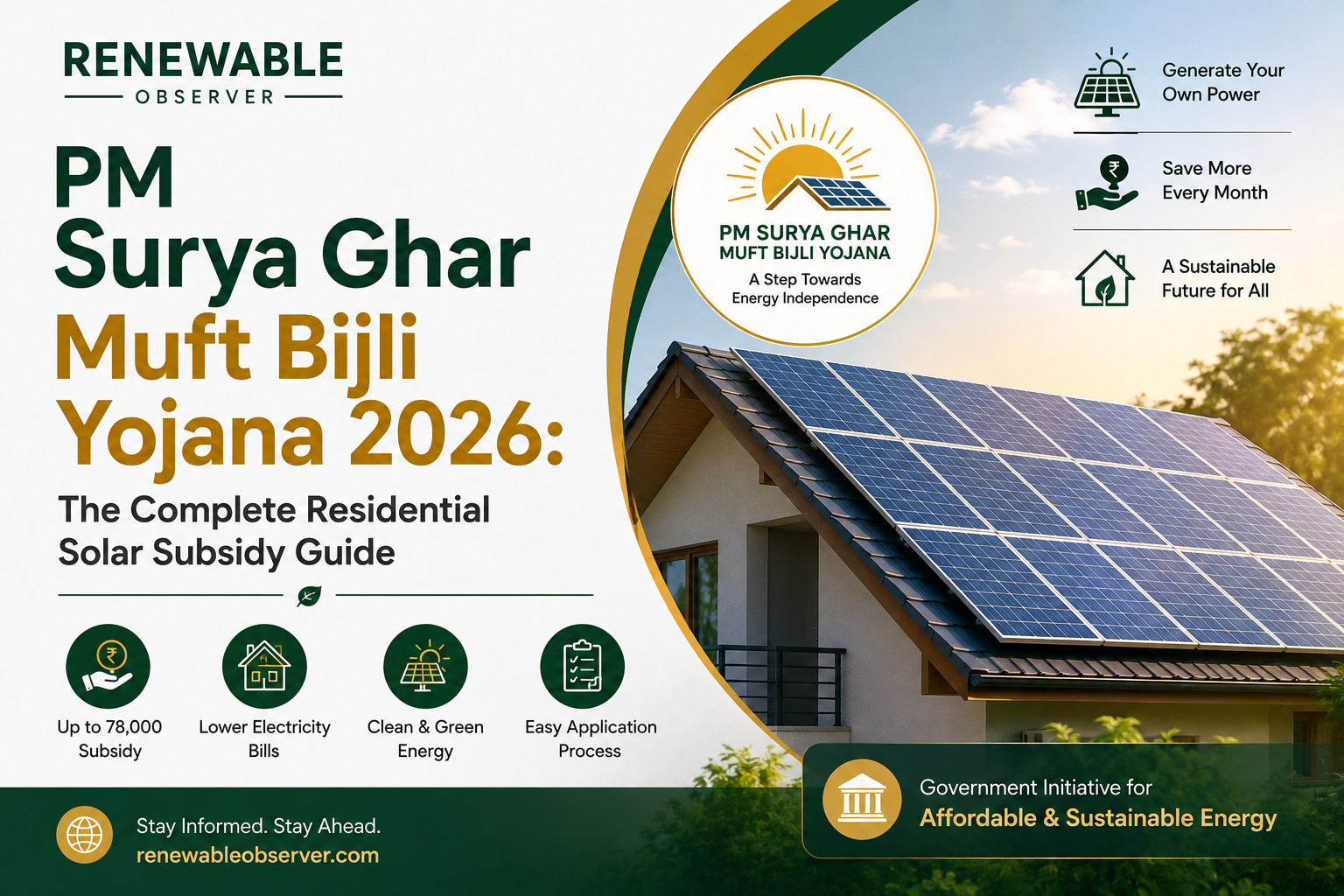
  • PM Surya Ghar Muft Bijli Yojana 2026: The Complete Residential Solar Subsidy Guide

    PM Surya Ghar Muft Bijli Yojana 2026: The Complete Residential Solar Subsidy Guide

    India is undergoing a massive transformation in residential clean energy, driven by the Central Government’s flagship initiative: the PM Surya Ghar: Muft Bijli Yojana. If you are a homeowner looking to cut your electricity bills to near zero, 2026 is the prime time to transition to rooftop solar.

    Here is a comprehensive breakdown of the scheme’s current status, exactly how much money you can save, and the critical rules you must follow to secure your subsidy in 2026.

    1. What is the PM Surya Ghar Yojana?

    Launched to empower residential households to generate their own electricity, the PM Surya Ghar Muft Bijli Yojana is India’s largest residential solar scheme.

    • The Goal: The scheme targets the solarisation of one crore households (10 million homes) by the financial year 2026-27.
    • The Budget: It is backed by a massive ₹75,021 crore central allocation.
    • The Progress (2026 Update): The scheme is moving at an unprecedented pace. As of mid-July 2026, the scheme has benefited 4.65 million households across the country, with roughly 100,000 households installing systems every week.

    The core benefit of the scheme is providing up to 300 units of free electricity monthly through a combination of upfront rooftop solar subsidies and standard net metering. This initiative is a vital component of India’s broader renewable energy policy targets.

    2. The 2026 Subsidy Breakdown

    The Ministry of New and Renewable Energy (MNRE) has simplified the subsidy structure. The Central Financial Assistance (CFA) is fixed based on the capacity of the system you install, capped at a maximum of 3 kW.

    The central subsidy is transferred directly to the customer’s bank account via Direct Benefit Transfer (DBT) after the local DISCOM commissions the system.

    • 1 kW System: ₹30,000.
    • 2 kW System: ₹60,000.
    • 3 kW System (and above): ₹78,000 (Maximum Cap).

    Note on Larger Systems: If you install a 5 kW or 10 kW system, your central subsidy remains capped at exactly ₹78,000. The system capacity you apply for also cannot exceed your home’s officially sanctioned electrical load, which typically must be 10 kW or below for residential connections under this scheme.

    For Housing Societies: Group Housing Societies and RWAs can also benefit, with subsidies of ₹18,000 per kW for common facilities (like lifts and corridor lighting), up to 500 kW overall.

    3. State-Level “Top-Up” Subsidies

    While the Central Government provides the ₹78,000 base, several state governments offer lucrative “top-up” subsidies to accelerate adoption in local solar energy markets.

    • Gujarat: Gujarat remains the national leader in the scheme, currently ranking first with over 1.06 million households covered. The state provides an additional ₹10,000–₹20,000 state subsidy for residential rooftop solar.
    • Maharashtra & Uttar Pradesh: Following closely behind Gujarat are Maharashtra with 1.04 million households and Uttar Pradesh with 676,000 installations. UP offers a flat state subsidy of ₹30,000 for systems of 3 kW or more, bringing the total potential subsidy to ₹1.08 lakh.
    • Delhi: Similar to UP, the Delhi government offers a state subsidy capped at Rs. 30,000 for systems of 3 kWp or more, allowing residents to claim a cumulative subsidy of up to Rs. 1.08 lakh.
    • Rajasthan: Residents in Rajasthan can receive an additional ₹17,000 state top-up via RREC.

    4. Critical 2026 Rules: The ALMM Mandate

    The most important rule to be aware of in 2026 is the strict enforcement of the Approved List of Models and Manufacturers (ALMM).

    • The Requirement: To qualify for the subsidy, you must use panels that are manufactured in India and listed on the ALMM.
    • The June 1, 2026 Update: The rules have become stricter. As of June 1, 2026, compliance extends to ALMM List II for cells. This means the solar modules must not only be made in India, but they must also be manufactured using domestically certified Indian cells.
    • The Risk: Using non-ALMM equipment to save on upfront costs is the most expensive mistake in residential solar in 2026. If your panels are not on the current ALMM List at the time of installation, your entire subsidy claim will fail.

    5. How to Apply

    The entire application process has been digitized through a national portal.

    1. Register Online: Visit the official PM Surya Ghar National Portal and register using your mobile number and Electricity Consumer Number.
    2. Feasibility Approval: Your local DISCOM will review your application and grant technical feasibility, usually within 7 to 21 days depending on feeder loading.
    3. Choose a Vendor: You must select a registered, DISCOM-empanelled vendor from the portal to install your system.
    4. Net Metering & Commissioning: Once installed, you submit a completion report, and the DISCOM will inspect the system, fit a Net Meter, and generate a commissioning certificate.
    5. Receive Funds: After submitting your bank details, the central subsidy is typically credited to your account via DBT within 30 to 45 days of commissioning.
  • BikeWo Partners with Yubhas Renewables to Advance Solar-Assisted EVs for Rural Last-Mile Mobility

    BikeWo Green Tech Limited has partnered with Yubhas Renewables Private Limited to commence operational validation of solar-assisted electric three-wheelers designed for rural and semi-urban mobility applications. Through the collaboration, BikeWo will leverage its rider network and operational expertise to evaluate the vehicle under commercial operating conditions ahead of its planned market deployment.

    The pilot programme will assess the vehicle’s performance across key parameters including range, battery efficiency, payload capacity, ride quality, thermal performance, braking, operating economics, and overall reliability under diverse operating conditions. Operational feedback from BikeWo’s last-mile network will be used to refine the vehicle’s design and performance ahead of wider market deployment.

    Beyond technology validation, the partnership seeks to create a broader ecosystem that combines clean mobility with rural entrepreneurship. The two companies are exploring a rural development initiative to train young people in vehicle operations, maintenance, customer service, and business management, enabling them to become owner-operators and build sustainable livelihoods through clean transportation.

    As part of the initiative, eligible participants may also be able to access financing opportunities under the Pradhan Mantri MUDRA Yojana, subject to applicable eligibility criteria and lender approvals. The long-term objective is to enable trained individuals to become owner-operators of solar-assisted electric vehicles that can support passenger transport, agricultural logistics, village deliveries, healthcare access, and other essential last-mile services while generating sustainable income for rural families.

    Commenting on the partnership, Hiten Pal Saklani, CEO, BikeWo Green Tech Limited, said, “At BikeWo, we are constantly exploring innovative mobility solutions that improve operational efficiency while contributing to a more sustainable future. Partnering with Yubhas Renewables provides an opportunity to evaluate a promising clean mobility technology under commercial operating conditions while exploring new avenues for rural entrepreneurship and livelihood generation.”

    Sai Satyam Pradhan, Founder & CEO, Yubhas Renewables, said, “Our vision is to build a practical solar-assisted mobility platform that addresses the unique transportation needs of rural India. Partnering with BikeWo gives us access to valuable operational feedback that will help refine the vehicle for reliability, affordability, and commercial viability. Beyond the technology, we see this as an opportunity to create a sustainable ecosystem where clean mobility can support entrepreneurship, generate livelihoods, and improve access to essential services across rural communities.”

    The partnership underscores BikeWo’s commitment to supporting next-generation clean mobility technologies while enhancing operational efficiency for its rider network. Together, BikeWo and Yubhas Renewables aim to build a scalable ecosystem that accelerates sustainable transportation, strengthens rural entrepreneurship, and contributes to India’s transition towards greener, more inclusive mobility solutions.

  • “We are focused on building energy systems that combine generation, storage, flexibility, and reliability,” says Ratul Puri, Chairman, Hindustan Power

    “We are focused on building energy systems that combine generation, storage, flexibility, and reliability,” says Ratul Puri, Chairman, Hindustan Power

    In an exclusive dialogue with Renewable Observer, Mr. Ratul Puri, Chairman of Hindustan Power, discusses the company’s evolution from pioneering India’s earliest solar projects to building a robust 5 GW diversified energy portfolio. He sheds light on the critical role of Battery Energy Storage Systems (BESS), the necessity of integrated power infrastructure, and the strategic importance of their recent 800 MW long-term agreement with Madhya Pradesh.

    Q1. Hindustan Power has been a pioneer in India’s renewable energy sector. Can you take us through the company’s journey and some of the key milestones that have shaped its growth?

    Ratul Puri: India’s energy landscape has witnessed a remarkable transformation over the past two decades, and Hindustan Power has been an integral part of that journey since its early stages. We entered the renewable energy sector when solar power was still an emerging technology, long before it became a central pillar of India’s energy transition.

    Some of our defining early achievements include developing India’s first 5 MW solar power project in 2010 and Asia’s first 30 MW solar PV project in 2011. These projects were important not only because they broke new ground technologically, but because they practically demonstrated that large-scale renewable energy could be commercially viable and contribute meaningfully to the country’s energy mix.

    As the sector evolved, so did our vision. We expanded our presence across renewable energy, transitional power generation, and supporting infrastructure—building capabilities that allow us to address both sustainability and energy security requirements. In recent times, we have strengthened our focus on battery energy storage and integrated energy solutions, recognizing that the future of the sector will be shaped by the reliable delivery of clean energy.

    Today, as we work toward building a 5 GW energy portfolio, our focus remains steadfast on creating scalable, future-ready infrastructure that supports India’s economic growth while contributing to a more sustainable and resilient energy ecosystem.

    Q2. The company developed India’s first 5 MW solar plant and Asia’s first 30 MW solar PV project. How have these early achievements influenced your long-term strategy in clean energy?

    Ratul Puri: Those projects were highly significant in terms of their scale at the time, proving that renewable energy could transition from concept to commercial viability. They gave us firsthand experience in developing, financing, and operating large clean energy assets in a market that was still finding its footing.

    More importantly, those early projects taught us that energy transitions are never static. Technologies evolve, customer expectations change, and grid requirements become significantly more complex. That understanding continues to shape our strategy today.

    We are moving beyond a purely capacity-focused approach to renewables. We are focused on building energy systems that combine generation, storage, flexibility, and reliability.

    The lessons from our early investments in solar energy taught us the value of staying ahead of technology cycles and anticipating future trends, rather than simply responding to where the market stands today. That perspective continues to guide our investments and strategic priorities as the energy landscape evolves.

    Q3. As India accelerates its energy transition, what opportunities do you see for renewable energy developers in supporting the country’s sustainability and energy security goals?

    Ratul Puri: India’s energy transition presents one of the most significant opportunities globally. As the country pursues rapid economic growth, industrial expansion, and digital transformation, the demand for reliable, affordable, and sustainable energy will continue to rise.

    The opportunity today extends far beyond simply adding renewable energy capacity. Developers are increasingly becoming partners in strengthening national energy security by delivering integrated energy solutions that enhance reliability, support grid stability, and reduce dependence on imported fuels.

    We are also witnessing new demand drivers emerge from manufacturing, digital infrastructure, and data centers. These sectors require massive volumes of clean electricity delivered consistently and competitively. Renewable energy developers that can successfully combine scale, technology, and execution excellence will play a critical role in supporting India’s sustainability goals while strengthening the country’s long-term energy resilience.

    Q4. Hindustan Power is actively expanding into solar-plus-storage solutions. How do you see battery energy storage transforming the renewable energy landscape in India?

    Ratul Puri: Battery energy storage is set to become one of the defining technologies of India’s energy transition. Over the past decade, the focus was largely on adding renewable generation capacity. The future of the energy transition, however, will be defined by aligning clean energy availability with consumer demand and usage patterns.

    In many ways, storage is the bridge between renewable energy generation and grid reliability. As renewable penetration increases, storage will play a critical role in:

    • Balancing supply and demand.
    • Supporting grid stability.
    • Enabling round-the-clock (RTC) clean power.
    • Cutting down curtailment and managing peak demand.

    At Hindustan Power, we see storage as a strategic growth area and a key enabler of the future electricity system. As of 2025, we had expanded our battery storage portfolio to more than 750 MWh across multiple states, including projects with SECI, SJVN, and BSPGCL. These investments reflect our core belief that solar-plus-storage will increasingly become the preferred model for delivering flexible and scalable clean energy in India.

    Q5. The company operates across both renewable and transitional energy businesses. How do you balance reliability, affordability, and sustainability while planning future projects?

    Ratul Puri: The energy transition is often discussed purely in terms of sustainability, but long-term success will equally be defined by reliability and affordability. These three objectives are deeply interconnected and cannot be pursued in isolation.

    Our planning approach is guided by a simple principle: every energy system must be able to provide dependable power at competitive costs while progressively reducing its environmental footprint. This requires a balanced portfolio approach that combines rapid renewable energy growth with the technologies and infrastructure capable of supporting grid stability.

    As India’s power demand continues to grow, the transition must support economic development, industrial competitiveness, and energy security. We therefore view renewable energy, energy storage, and enabling infrastructure as complementary elements of an integrated ecosystem that can deliver power at scale.

    Q6. Innovation and large-scale project execution have been central to Hindustan Power’s success. What recent technological advancements or project developments are you most excited about?

    Ratul Puri: One of the most exciting developments in the sector today is the convergence of renewable energy, battery storage, and advanced power infrastructure. The industry is moving beyond standalone generation assets toward integrated systems that deliver cleaner and more flexible power.

    From our perspective, the rapid scale-up of our battery energy storage portfolio is particularly encouraging. Storage is transforming the economics and operational capabilities of renewable energy by enabling firm and dispatchable power—which will become increasingly important as electricity demand continues to rise across industries, mobility, and digital infrastructure.

    We are seeing growing acceptance of dispatchable renewable power models across utilities and state agencies, creating opportunities to build infrastructure that combines clean generation with grid support.

    We are also encouraged by advancements in ultra-supercritical generation technology, digital asset optimization, and predictive operational systems that are improving efficiency across the power value chain. Competitive advantage moving forward will come from combining these diverse technologies.

    Q7. Hindustan Power recently signed a 25-year Power Supply Agreement with MP Power Management Company for supplying 800 MW from its upcoming Anuppur project. How does this milestone align with your long-term vision?

    Ratul Puri: The agreement is a significant achievement in our growth journey and reflects our long-term commitment to building large-scale power infrastructure that supports India’s development ambitions. The project will supply 800 MW of power to Madhya Pradesh under a 25-year agreement, providing long-term visibility while helping meet the state’s growing electricity requirements. It represents a major addition to our infrastructure portfolio and demonstrates our confidence in India’s rapidly evolving energy markets.

    From a strategic perspective, the project reflects our belief that India’s energy transition will require both renewable energy expansion and dependable power infrastructure capable of supporting industrialization. Reliable baseload power will continue to play an important role as the country scales its renewable and storage capacities.

    The Anuppur project also builds on our established presence in Madhya Pradesh and demonstrates confidence in our ability to develop and operate large, technologically advanced energy assets using ultra-supercritical technology. As India enters what I often describe as the next critical phase of its energy transition, our focus will remain entirely on delivering integrated, resilient, and scalable solutions for decades to come.

  • DCM Shriram Ltd. signs definitive agreement with Serentica Renewables to source 58 MW of Renewable Energy for its facilities in Bharuch, Gujarat

    DCM Shriram Limited has entered into a definitive agreement with Serentica Renewables India 38 Pvt. Ltd. for the development of a 58 MW peak hybrid renewable energy power project, primarily for its energy-intensive business in Bharuch, Gujarat. Upon completion, DCM Shriram’s total renewable energy capacity will rise to 176 MW (peak) across it two sites in Bharuch & Kota, significantly expanding its clean energy base. The project is expected to be commissioned by June 2027. Under the agreement, DCM Shriram Limited will invest up to Rs. 105 crores in one or more tranches to acquire a minimum 26% equity stake in Serentica Renewables India 38 Pvt. Ltd.

    Commenting on the development, Mr. Sabaleel Nandy, Executive Director & CEO, DCM Shriram Chemicals, said, “The agreement is a strategic step in expanding the share of renewable energy across our chemical operations in Bharuch and our ongoing efforts towards making the business more sustainable. The project is expected to help avoid nearly 0.4 million tonnes of CO₂ emissions annually while increasing the share of renewable power. Further given, that power is one of the most significant input costs,this will help improve cost efficiency, provide greater visibility into long-term power costs and reduce exposure to fluctuations in conventional energy prices.”

    Commenting on the partnership, Mr. Akshay Hiranandani, CEO, Serentica Renewables, said, “Our partnership with DCM Shriram Chemicals marks another significant step in advancing India’s industrial decarbonization journey. Through a 190 MW renewable energy project comprising solar power from Rajasthan and wind power from Karnataka, we will supply 58 MW renewable power to DCM Shriram Chemicals Bharuch plant, enabling reliable and sustainable energy for its operations.’’

    The agreement strengthens DCM Shriram Chemicals renewable energy portfolio while supporting the long-term energy requirements of its Bharuch operations. Once commissioned, the project is expected to contribute meaningfully to the company’s efforts to improve energy efficiency, reduce emissions and build a more resilient and sustainable manufacturing base.

  • Emmvee Reports Record Q1 FY27 Performance, Revenue Rises 51% to INR 1,555.5 Crore

    Emmvee Reports Record Q1 FY27 Performance, Revenue Rises 51% to INR 1,555.5 Crore

    Emmvee Photovoltaic Power Limited (NSE: EMMVEE; BSE: 544608) has reported its strongest-ever first-quarter performance for the quarter ended June 30, 2026, driven by higher production volumes, increased internal solar cell manufacturing and improved operational efficiencies across its expanded manufacturing base.

    The company’s revenue from operations increased 51% year-on-year to ₹1,555.5 crore in Q1 FY27, compared to ₹1,027.8 crore in the corresponding quarter of the previous fiscal year. EBITDA grew 56% to ₹548.1 crore, while EBITDA margin expanded to a record 35.2% from 34.1% in Q1 FY26 and 32.8% in Q4 FY26. Profit after tax (PAT) more than doubled, rising 103% to ₹380.3 crore, with PAT margin improving to an all-time high of 24.2%.

    Despite Q1 traditionally being a seasonally softer period for module dispatches, Emmvee delivered strong financial growth supported by enhanced manufacturing integration and operating leverage.

    The company achieved its highest-ever quarterly production volumes during the quarter. Solar module production increased 53% year-on-year to 970 MW, compared with 635 MW in Q1 FY26, while solar cell production rose 26% to 454 MW from 360 MW during the same period.

    The effective utilisation of solar cell capacity improved significantly to 83% in Q1 FY27, compared with 68% in Q1 FY26 and 79% in Q4 FY26. The improvement was driven by the continued ramp-up of integrated operations and higher consumption of internally manufactured cells, which contributed to margin expansion. Meanwhile, effective module capacity utilisation stood at 45%, providing sufficient capacity headroom for future volume growth.

    As of the end of Q1 FY27, Emmvee had installed annual manufacturing capacity of approximately 10.3 GW for solar modules and 2.94 GW for TOPCon solar cells.

    The company also witnessed strong demand momentum, securing order inflows of 1.48 GW during the quarter. This increased its order book to an all-time high of approximately 9.9 GW, providing strong revenue visibility for the coming quarters. The order book remains diversified across independent power producers, commercial and industrial customers, and other segments, with repeat customers accounting for 57% of the order base during the quarter.

    Emmvee’s inclusion in the Approved List of Models and Manufacturers (ALMM) List II, implemented from June 2026, is expected to support demand growth as the framework mandates the use of domestically manufactured solar cells for applicable projects. The company expects this policy development to further accelerate its transition towards a fully DCR-compliant product portfolio.

    Commenting on the performance, Mr. DV Manjunatha, Chairman & Managing Director, Emmvee Photovoltaic Power Ltd., said, “This is the strongest first quarter in Emmvee’s history, with both production volumes and margins at all-time-high. Our revenue, EBITDA and PAT growth reflects a clear improvement in the quality of our earnings, driven by deeper cell integration, operating leverage and disciplined execution.”

    He added, “Our strong order book, the implementation of ALMM List II and our on-track 6 GW integrated expansion give us confidence as we enter the next phase of India’s solar manufacturing growth.”

    The company’s 6 GW integrated TOPCon cell and module expansion project is progressing as planned. The module manufacturing line is expected to be commissioned by December 2026, while the cell line is targeted for commissioning by March 2027. Once completed, the expansion will increase Emmvee’s installed capacity to approximately 16.3 GW of modules and 8.9 GW of cells by early FY28.

    The company has already placed equipment orders covering around 60% of the project’s total hard cost, with construction activities progressing as per schedule. Emmvee is also evaluating backward integration into ingot and wafer manufacturing through a proposed 9 GW facility planned in two phases.

    With expanding manufacturing capacity, a strong order pipeline and increased focus on integrated solar production, Emmvee aims to strengthen its position in India’s growing domestic solar manufacturing ecosystem.

  • Emmvee Reports Record Q1 FY27 Performance, Revenue Rises 51% to INR 1,555.5 Crore

    Emmvee Reports Record Q1 FY27 Performance, Revenue Rises 51% to INR 1,555.5 Crore

    Emmvee Photovoltaic Power Limited (NSE: EMMVEE; BSE: 544608) has reported its strongest-ever first-quarter performance for the quarter ended June 30, 2026, driven by higher production volumes, increased internal solar cell manufacturing and improved operational efficiencies across its expanded manufacturing base.

    The company’s revenue from operations increased 51% year-on-year to ₹1,555.5 crore in Q1 FY27, compared to ₹1,027.8 crore in the corresponding quarter of the previous fiscal year. EBITDA grew 56% to ₹548.1 crore, while EBITDA margin expanded to a record 35.2% from 34.1% in Q1 FY26 and 32.8% in Q4 FY26. Profit after tax (PAT) more than doubled, rising 103% to ₹380.3 crore, with PAT margin improving to an all-time high of 24.2%.

    Despite Q1 traditionally being a seasonally softer period for module dispatches, Emmvee delivered strong financial growth supported by enhanced manufacturing integration and operating leverage.

    The company achieved its highest-ever quarterly production volumes during the quarter. Solar module production increased 53% year-on-year to 970 MW, compared with 635 MW in Q1 FY26, while solar cell production rose 26% to 454 MW from 360 MW during the same period.

    The effective utilisation of solar cell capacity improved significantly to 83% in Q1 FY27, compared with 68% in Q1 FY26 and 79% in Q4 FY26. The improvement was driven by the continued ramp-up of integrated operations and higher consumption of internally manufactured cells, which contributed to margin expansion. Meanwhile, effective module capacity utilisation stood at 45%, providing sufficient capacity headroom for future volume growth.

    As of the end of Q1 FY27, Emmvee had installed annual manufacturing capacity of approximately 10.3 GW for solar modules and 2.94 GW for TOPCon solar cells.

    The company also witnessed strong demand momentum, securing order inflows of 1.48 GW during the quarter. This increased its order book to an all-time high of approximately 9.9 GW, providing strong revenue visibility for the coming quarters. The order book remains diversified across independent power producers, commercial and industrial customers, and other segments, with repeat customers accounting for 57% of the order base during the quarter.

    Emmvee’s inclusion in the Approved List of Models and Manufacturers (ALMM) List II, implemented from June 2026, is expected to support demand growth as the framework mandates the use of domestically manufactured solar cells for applicable projects. The company expects this policy development to further accelerate its transition towards a fully DCR-compliant product portfolio.

    Commenting on the performance, Mr. DV Manjunatha, Chairman & Managing Director, Emmvee Photovoltaic Power Ltd., said, “This is the strongest first quarter in Emmvee’s history, with both production volumes and margins at all-time-high. Our revenue, EBITDA and PAT growth reflects a clear improvement in the quality of our earnings, driven by deeper cell integration, operating leverage and disciplined execution.”

    He added, “Our strong order book, the implementation of ALMM List II and our on-track 6 GW integrated expansion give us confidence as we enter the next phase of India’s solar manufacturing growth.”

    The company’s 6 GW integrated TOPCon cell and module expansion project is progressing as planned. The module manufacturing line is expected to be commissioned by December 2026, while the cell line is targeted for commissioning by March 2027. Once completed, the expansion will increase Emmvee’s installed capacity to approximately 16.3 GW of modules and 8.9 GW of cells by early FY28.

    The company has already placed equipment orders covering around 60% of the project’s total hard cost, with construction activities progressing as per schedule. Emmvee is also evaluating backward integration into ingot and wafer manufacturing through a proposed 9 GW facility planned in two phases.

    With expanding manufacturing capacity, a strong order pipeline and increased focus on integrated solar production, Emmvee aims to strengthen its position in India’s growing domestic solar manufacturing ecosystem.

  • Adani Energy Solutions Places Order for AL59 Aluminium Alloy Conductors for Power Transmission Expansion

    Adani Energy Solutions Places Order for AL59 Aluminium Alloy Conductors for Power Transmission Expansion

    Diamond Power Infrastructure (DPIL), an integrated manufacturer of power transmission and distribution equipment under the DICABS brand, has announced that it has received a Contract Confirmation / Letter of Award from Adani Energy Solutions (AESL) for the supply of AL59 aluminium alloy conductors for two of AESL’s transmission projects.

    The award encompasses the design, engineering, manufacturing, testing, packing, dispatch and transportation, on a Delivery-at-Place (DAP) basis, of 1,050 km of AL59 Moose conductor for the Tuticorin Project and 3,770 km of AL59 Zebra conductor for the Pune-III Project.

    The order is valued at INR 1,85,16,45,098/- (approximately INR 185.16 Crore) inclusive of packing, forwarding, freight and transit insurance and exclusive of GST aggregating to approximately INR 218.49 Crore including GST. The contract is on a variable-price basis linked to aluminium LME and USD/INR movements through an agreed price variation formula, and the realised value may therefore differ. Deliveries are scheduled between July 2026 and February 2027.

    Commenting on the award, Kavish Shah, Vice President Corporate Strategy of Diamond Power Infrastructure, said, “continued confidence of a marquee customer in DPIL’s conductor manufacturing capability; the order builds on the Company’s existing relationship with AESL; supports visibility for FY27; and reflects the growth in India’s transmission capex cycle.”

  • Adani Energy Solutions Places Order for AL59 Aluminium Alloy Conductors for Power Transmission Expansion

    Adani Energy Solutions Places Order for AL59 Aluminium Alloy Conductors for Power Transmission Expansion

    Diamond Power Infrastructure (DPIL), an integrated manufacturer of power transmission and distribution equipment under the DICABS brand, has announced that it has received a Contract Confirmation / Letter of Award from Adani Energy Solutions (AESL) for the supply of AL59 aluminium alloy conductors for two of AESL’s transmission projects.

    The award encompasses the design, engineering, manufacturing, testing, packing, dispatch and transportation, on a Delivery-at-Place (DAP) basis, of 1,050 km of AL59 Moose conductor for the Tuticorin Project and 3,770 km of AL59 Zebra conductor for the Pune-III Project.

    The order is valued at INR 1,85,16,45,098/- (approximately INR 185.16 Crore) inclusive of packing, forwarding, freight and transit insurance and exclusive of GST aggregating to approximately INR 218.49 Crore including GST. The contract is on a variable-price basis linked to aluminium LME and USD/INR movements through an agreed price variation formula, and the realised value may therefore differ. Deliveries are scheduled between July 2026 and February 2027.

    Commenting on the award, Kavish Shah, Vice President Corporate Strategy of Diamond Power Infrastructure, said, “continued confidence of a marquee customer in DPIL’s conductor manufacturing capability; the order builds on the Company’s existing relationship with AESL; supports visibility for FY27; and reflects the growth in India’s transmission capex cycle.”