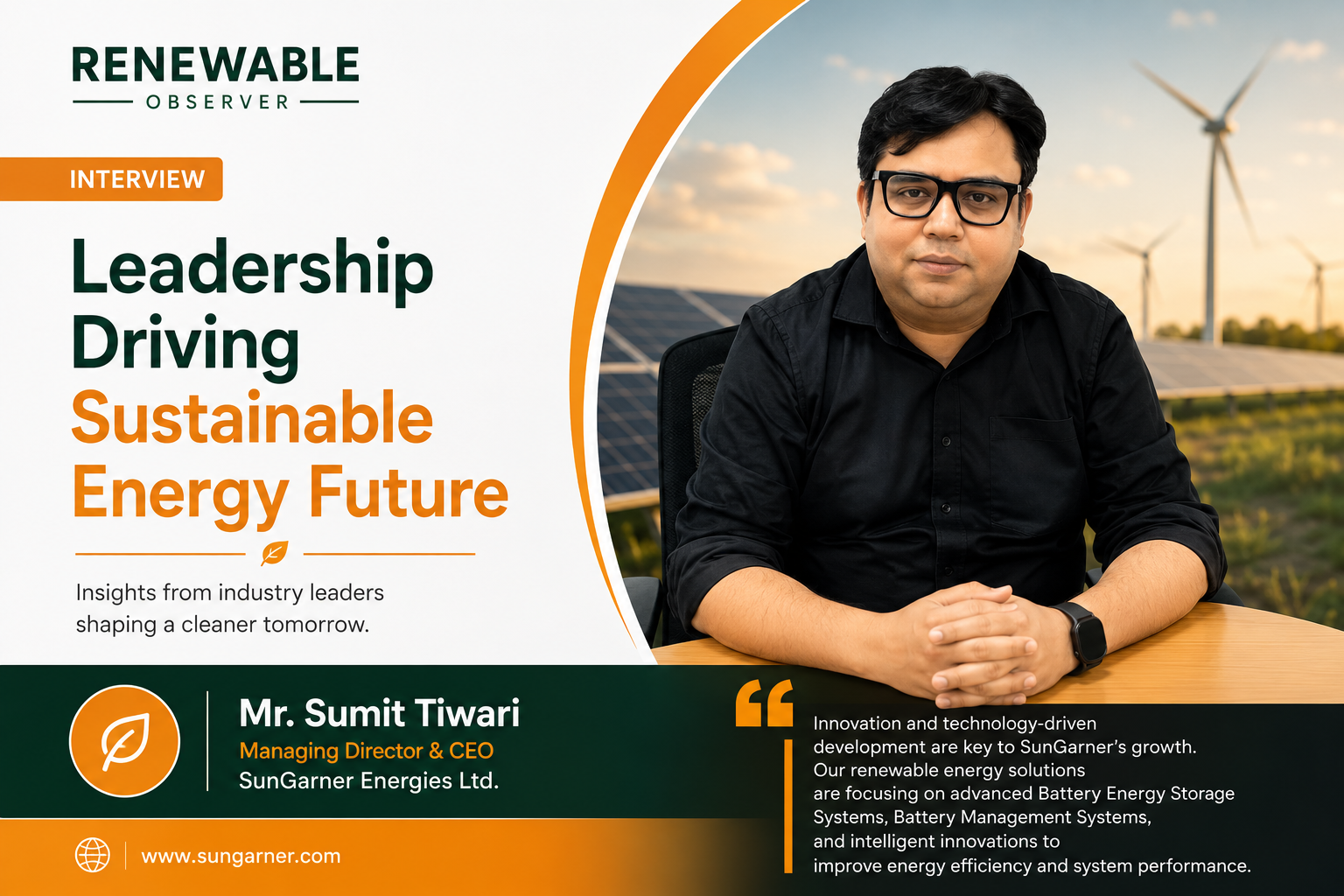
In an exclusive dialogue with Renewable Observer, Sumit Tiwari, MD & CEO of SunGarner Energies Ltd., maps out the company’s decade-long evolution from a rooftop solar EPC to a publicly listed, integrated renewable energy solutions provider. He discusses the critical shift toward indigenous manufacturing under the Make in India initiative, the booming potential of Battery Energy Storage Systems (BESS), and SunGarner’s strategic pivot into renewable asset ownership.
Q1. SunGarner has grown significantly over the years. What key milestones have shaped the company’s journey and success?
Sumit Tiwari: SunGarner’s journey has been defined by continuous evolution and our ability to adapt to the rapidly changing dynamics of the renewable energy industry.
We started in 2015 as a Solar Rooftop EPC company, focusing strictly on delivering quality solar solutions to commercial and industrial (C&I) customers. As the market matured, we recognized the need to diversify into power electronics, initiating manufacturing activities in 2017 and significantly expanding those capabilities in 2018.
A monumental milestone came in 2023 when SunGarner became a publicly listed company, marking a new chapter of growth, governance, and transparency. By 2024, we had expanded into Lithium-Ion Battery Manufacturing and Solar IPP (Independent Power Producer) businesses, solidifying our position across the entire renewable energy value chain. Today, we have executed projects across 26 Indian states, established solar power plants in over 12 states, exported to five countries, and developed more than 25 in-house SKUs of solar inverters and energy storage solutions.
Beyond these operational milestones, our biggest structural strength has always been our people. The dedication of our R&D, manufacturing, execution, and sales teams has enabled us to remain agile, embrace new technologies, and stay perfectly aligned with the evolving needs of the energy transition.
Q2. SunGarner offers solutions across solar, energy storage, EVs, and EPC. What differentiates your offerings in the highly competitive renewable energy market?
Sumit Tiwari: What sets SunGarner apart is that we are not merely a product company or a traditional EPC contractor—we are a fully integrated renewable energy solutions provider with deep, in-house capabilities encompassing technology development, manufacturing, power system engineering, and project execution.
We offer advanced energy storage solutions with more than 80% indigenous content, directly supporting the Government’s vision of self-reliance and domestic manufacturing.
Innovation has been the cornerstone of our journey. We were among the early pioneers in India to develop and commercialize Solar Online UPS systems, representing a significant technological leap over conventional solar inverters. Importantly, all of our inverter designs are developed entirely in-house by our engineering and R&D teams.
Furthermore, we do not believe in a one-size-fits-all approach. Every customer has a unique energy profile. We custom-design systems based on actual site conditions, spatial constraints, load patterns, diesel generator run hours, grid reliability, and specific commercial objectives. It is not just about selling a product; it is about engineering the most efficient, reliable energy ecosystem for every specific requirement.
Q3. Could you share some landmark projects executed by SunGarner and their impact on the business?
Sumit Tiwari: Every phase of our growth is anchored by projects that forced us to expand our capabilities and pushed us into new markets. A few defining milestones include:
- The Utility Scale Leap (2018): We executed a 1.8 MWp rooftop solar installation for a textile manufacturing unit in Gorakhpur, Uttar Pradesh. At the time, it was our single largest project and proved our capacity to design and execute heavy C&I solar infrastructure.
- Global Expansion (2021): We delivered a 180 kW Solar Project for the Bhutan Power Corporation and UNDP in Bhutan. This was our first international project, validating our technical capabilities on a global stage.
- Energy Storage at Scale (2024): Through our channel partner network, we supplied in-house developed Solar Inverters and Battery Energy Storage solutions to more than 200 distinct sites in Tripura under a TREDA-led initiative, showcasing the rugged reliability of our indigenous technology in challenging environments.
- IPP Transition & Ground-Mount Projects (2025): We aggressively entered the utility-scale segment, developing ground-mounted projects in Madhya Pradesh, including a 4.5 MWp DC installation at Kutiyawad. Crucially, our subsidiary, SunGarner Green Assets, signed a Power Purchase Agreement (PPA) with MPUVNL under the Kusum Yojana. This firmly established our footing in the IPP business, laying the foundation for a long-term renewable asset portfolio.
Q4. How is SunGarner leveraging innovation and R&D to address the evolving needs of the solar and energy storage sectors?
Sumit Tiwari: Innovation and technology development are the primary engines of our growth strategy. As the sector evolves, our R&D is heavily focused on advancing Battery Energy Storage Systems (BESS), intelligent Battery Management Systems (BMS), and next-generation inverter technologies to maximize energy efficiency and grid reliability.
A major focus is the integration of indigenous technologies aligned with the Make in India initiative. By strengthening localized capabilities in energy storage and power electronics, we are actively reducing import dependencies while delivering high-performance solutions engineered specifically for harsh Indian operating conditions.
Simultaneously, through our IPP platform, SG Green Asset, we are utilizing our R&D insights to develop, own, and operate renewable assets that deliver highly optimized, sustainable power to C&I customers over the long term.
Q5. What specific growth opportunities do you see in BESS, EV charging infrastructure, and distributed solar solutions?
Sumit Tiwari: We believe India is at the very beginning of a multi-decade clean energy transformation. Consider that India’s solar capacity has grown from roughly 2 GW in 2011 to over 120 GW today. Following that exact trajectory, BESS is poised to become the next critical pillar of the country’s infrastructure.
As the share of intermittent solar and wind energy increases, energy storage will be absolutely essential for ensuring reliability, smoothing peak demand, and providing firm power supply across the grid.
We also see massive, untapped growth in distributed solar solutions—spanning rooftop installations, ground-mounted PM Kusum Yojana projects, and C&I infrastructure. Parallel to this, the exponential growth of electric mobility is driving urgent demand for EV charging ecosystems. SunGarner is strategically positioned at the exact intersection of these trends, offering an integrated suite of solar inverters, lithium-ion storage solutions, and EV infrastructure technologies to capitalize on this holistic transition.
Q6. How does SunGarner ensure quality, reliability, and long-term value across its EPC and product businesses?
Sumit Tiwari: With a proven track record of over 10,000 installations across India, quality control is woven into our operational DNA.
We enforce stringent quality gateways throughout the entire project lifecycle—from initial design and structural engineering to procurement, commissioning, and after-sales support. We partner only with trusted technology vendors and source high-grade components that exceed standard industry performance metrics.
Because solar and storage assets must perform for decades, we emphasize long-term value creation through continuous performance monitoring, preventative maintenance protocols, and operational optimization, ensuring our customers realize sustainable financial returns throughout the system’s complete lifecycle.
Q7. What are SunGarner’s key growth priorities and expansion plans to accelerate India’s clean energy transition?
Sumit Tiwari: Our priorities are moving in lockstep with India’s national vision for energy security and self-reliance (Atmanirbhar Bharat).
Our primary focus is deepening our capabilities across the full value chain. The next phase of India’s energy transition will not be driven by solar generation alone; it will be dictated by advanced storage and intelligent power management. Accordingly, we are heavily investing in our in-house manufacturing lines for ESS and advanced power conversion technologies.
Another critical growth pillar is the rapid expansion of our IPP business. We aim to build a massive, diversified portfolio of renewable and storage assets that provide reliable, affordable power at scale. We are also targeting hybrid energy systems and aggressive C&I decarbonization frameworks.
Ultimately, at SunGarner, we believe that clean energy is not just a business opportunity—it is a nation-building opportunity. Our vision is to help actively shape an energy-independent India while generating sustainable value for our customers, communities, and shareholders.
Leave a Reply